What can a nail-biting tracker actually tell you?
You bite a nail after several days without biting. The counter resets. But what happened to the changes you could see in your other nails, or the days you remembered to check in?
A single number can’t answer all of that. Photos show how your nails looked on particular dates. Logs record the urges and biting you noticed. A streak counts a run of days. Each leaves something out.
We build Nonyxa, which combines fingertip photos with urge and damage logs. Here’s what those records can tell you—and what you still have to work out yourself.
Photos give you something to compare with your memory
“My nails look the same” is hard to check without an earlier picture. With dated photos, you can look at the same fingertip at two points in time: the edge of the nail, its length, and the skin around it.
In Nonyxa, your first check-in sets the baseline. On later check-ins, today’s fingertip appears above the same finger from your most recent completed check-in. You compare them and mark Clean or Damaged yourself. The app doesn’t decide that from the image.
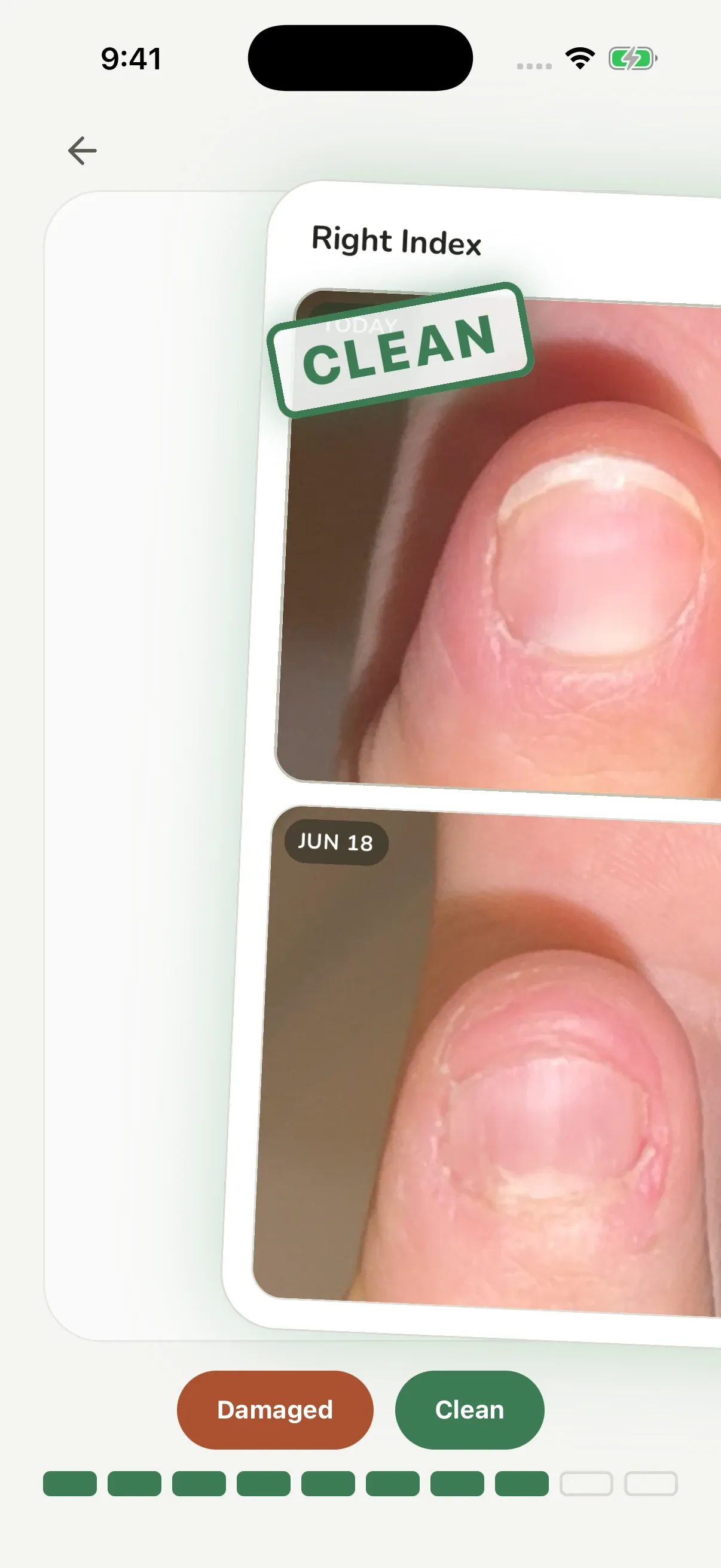
For a longer view, Progress lets you choose a finger and two dates. That answers a different question from the daily check-in: how does this nail look compared with an earlier point in your history?
A photo still needs context. Trimming changes length. Polish can hide detail. A picture can show a difference without explaining what caused it. And a before-and-after pair is not proof that an app made someone stop biting.
The photo check-in walkthrough shows the capture and comparison steps.
Logs record the moments a photo can’t explain
A fingertip photo won’t tell you that you were watching TV when you started biting, or that you noticed a rough edge first. A note can.
Nonyxa lets you log an urge separately from damage and add a note. “Watching TV, noticed a rough edge” is enough to record the situation. If similar notes keep appearing, you have a specific situation to think about when planning what to do next.
The American Academy of Dermatology recommends identifying nail-biting triggers, along with measures such as keeping your hands busy with another activity. A log is one way to keep track of the situations you notice. That recommendation does not establish that Nonyxa itself reduces biting.
The limitation is easy to miss: your log contains what you recorded. An empty day doesn’t necessarily mean you had no urges or didn’t bite. You may simply not have noticed or logged it.
A damaged nail and a missed check-in are different things
If you bite today, you can still photograph your nails, compare each fingertip, and finish your check-in. Those actions still happened.
Nonyxa keeps the clean streak and check-in streak separate. Recording damage affects the clean streak; completing your daily photo check-in still counts toward the check-in streak. Earlier photos remain in your history.
That gives you a more useful answer than a reset counter alone. You can see the damage you recorded today and look back at the rest of your record, including the other fingers.
Use the record to decide what to do next
Start with the question you’re trying to answer. To see whether a nail looks different, compare its photos. To recall what was happening around an urge, review your logs. To see whether you’ve kept up the daily routine, look at your check-ins.
Recording those things doesn’t interrupt every bite or tell you which strategy will work for you. It gives you a record to return to instead of having to reconstruct everything from memory.
If that’s the record you want, see how Nonyxa works.